Effects on future generations
Temperature
Our Earth’s temperature has increased by 2 degrees Fahrenheit just in the 20th century. Which might not seem like a big deal but the Earth’s climate record demonstrates that the global average temperature has been secure over long periods of time. Even a small change in temperature can cause tremendous changes within the environment. Our impact today, not only will be present for the next generation but will be implacable for numerous decades yet to come. According to the article, Climate Change Isn’t Just a 21st Century Problem, 1,000 years from now our atmosphere will still have about 20-50 percent of airborne carbon emissions from human activities over the next 100 years. NASA has made anticipated projections within the regions of the U.S. according to the Third and Fourth National Climate Assessment Reports. Intense heat days which are one-day events, happen only once within every twenty years but are expected to happen at least once every two to three years by the end of this century. Heat waves will become more severe while cold waves becoming less severe throughout the entire nation as well. With heavy precipitation increasing, the Southwest will be largely impacted by severe flooding. This will not only bring erosion due to the drought-stricken areas but also cause for insect outbreaks as well. NASA states that: “Droughts in the Southwest and Central Plains of the United States in the second half of the 21st century could be drier and longer than anything humans have seen in those regions in the last 1,000 years, according to a NASA study published in Science Advances on February 12, 2015.” Not only is this terrifying to think about but it is also something that could potentially wipe out the population within that region.
Sea Levels
The sea levels have drastically risen globally. NASA also states that from 1880, they have risen about 8 inches. By 2100, it will rise anywhere from 1 to 4 feet. It will not stop from there though because the oceans take an extensive amount of time to adjust as the temperature of the Earth continues to get warmer. This is contributed by the growth of seawater as it increases in temperature and water that it melting from land ice. Storm surges as long with high tides could potentially bind with the rising sea levels and cause for more flooding to occur. This is drastic for coastal cities because they will literally begin to submerge, destroying the infrastructure and agriculture for each of these cities.
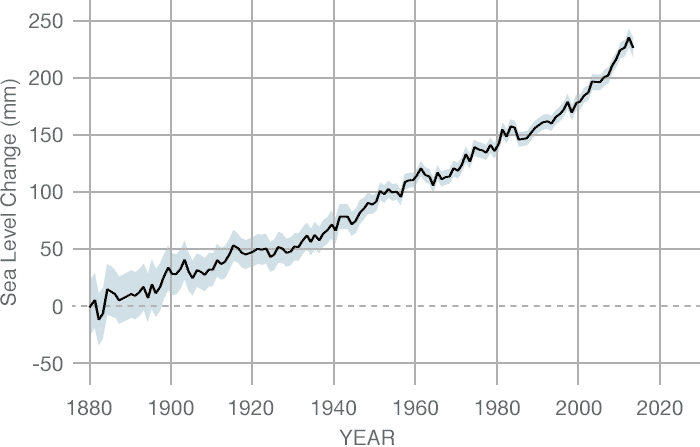
This graph obtained from the coastal tide gauge data shows sea level changes from 1870-2013.
Internal Human Evolution
Not only does climate change affect our planet but it will also cause for our bodies to adjust internally and externally. According to an article derived from NBC News, a warming climate indicates for diseases such as Malaria, West Nile virus, etc. to spread from the tropics into temperate zones. Our immune systems will be forced to evolve new defenses to be able to fight these diseases off. Unfortunately, sickle cell and thalassemia, which are both blood disorders emerged and are still ongoing due to the resistance to malaria. “Such disorders, or new ones, may soon appear if malaria moves into populated areas of North America, East Asia and Europe” (Climate change could affect human evolution. Here’s how). Not only will our immune system evolve but so will our digestive systems. They will need to advance due to the accessibility of food which will impacted to a great extent because of climate change.
External Human Evolution
Geographic barriers cause for the differences we see known as human races or population groups. As sea levels start rising and droughts become more and more intense, people will be forced to migrate to places with more reliable resources. A World Bank report which was released in March speculates that 150 million people will be forced to migrate by 2050 due to climate change. With extensive migrations as such, a consequence like gene flow will occur. Gene flow is when genetic differences pass on from one population to another. If and when the rate of gene flow is high, two populations will have similar allele frequencies causing there to be just one single population. The same article from NBC News states how an effect of gene flow would be the similarity of skin colors. Eumelanin is what makes skin darker but having too much causes for the body to have a hard time producing vitamin D which then also troubles the production of healthy bones. “In five to 10 generations (125 to 250 years), we may see fewer people with dark skin or pale skin and more with a brown or olive complexion” (Climate change could affect human evolution. Here’s how). Dark skin and light eyes will become more widespread in the future and people will be more physically similar to one another.
The following video is from Prince Ea and describes how big of an impact our mark will leave for future generations to come.
If you would like to contribute to saving our planet, I have attached a link where one is able to donate as well as support the Stand For Trees group. Any amount helps and is greatly appreciated. Thank you. https://standfortrees.org/en/
 Environmental Changes