How Climate Change Impacts Us
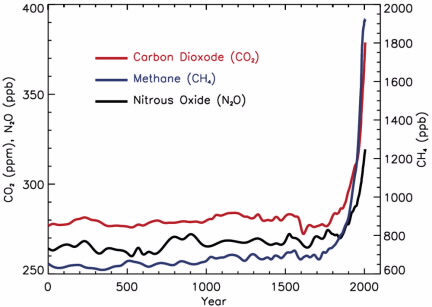
While humans have been around for thousands of years, the impact on climate change caused by humans has not been an issue until the industrial revolution of the 1800s. Only then did mankind begin to truly rely heavily on mass consumption and the use of fossil fuels. This growing reliance on fossil fuel usage led to a tremendous spike in carbon dioxide levels in our atmosphere. According to the American Chemistry Society: Until the past two centuries, the concentrations of CO2 and CH4 had never exceeded about 280 ppm and 790 ppb, respectively. Current concentrations of CO2 are about 390 ppm and CH4 levels exceed 1,770 ppb. Both numbers are much higher than at any time during the last 650,000 years. This indicates that the current levels of carbon dioxide are higher now than they have been in the entire existence of humankind, and all of this is thanks to humans in the last 200 years.
This increase in carbon dioxide leads to the formation of a barrier of Co2 that traps heat from escaping when it bounces off the earth’s surface. This is known as the Greenhouse Effect. This Greenhouse Effect impacts humans in several ways. One way it impacts us is the increased temperature of the planet due to the trapped heat is causing ice caps and glaciers to melt. This affects us because not only is this causing sea levels to rise, but it is also changing the chemical composition of our oceans. Also, with the rise in temperature of our oceans comes the expansion of water molecules themselves, thus contributing to the rise in sea levels. With 44% of mankind’s population (more people than inhabited the globe in 1950) living within 150 kilometers of the coast, we are already starting to see how the shifting sea levels are impacting human civilization. According to globalchange.gov, the Global sea level has risen by about 8 inches since scientific record keeping began in 1880 with 3 inches of that coming since just 1990. This has already led to increased levels of nuisance flooding due to shifts in oceanic trends across the globe. Recently in the beautiful lagoon city of Venice, Italy flood waters reached their highest peak in more than fifty years. This was caused by increasingly high tides that eventually overtook the barriers that protected the island city for centuries. Events like this are all too similar across the globe and is causing hefty infrastructural damage and forcing many people to abandon their homes and relocate. In a study done by Climate Central, they concluded that: the human-caused increase in global sea level also accounts for more than 80% of the increase in nuisance flood days between the period 1955-1984 and the period 1985-2014, periods across which flood frequency tripled for study gauges collectively. Anthropogenic climate change is not just a problem for the future: through sea level rise, it is driving most coastal flooding in the United States today. There are human fingerprints on thousands of recent floods. These findings show that the vast majority of all flooding events can be linked with the rise in global sea temperatures. Because of human’s overreliance on fossil fuels, the global warming of our planet will undoubtedly increase along with the rising of our ocean’s sea levels. Despite recent environmental planning like the Paris Climate accord, there is little we can do to undo the rise in sea levels and the best action would be to prepare for the eventually rise in our coastlines.
The following video is from Verge Science and explains the impact of melting ice.
 Environmental Changes